
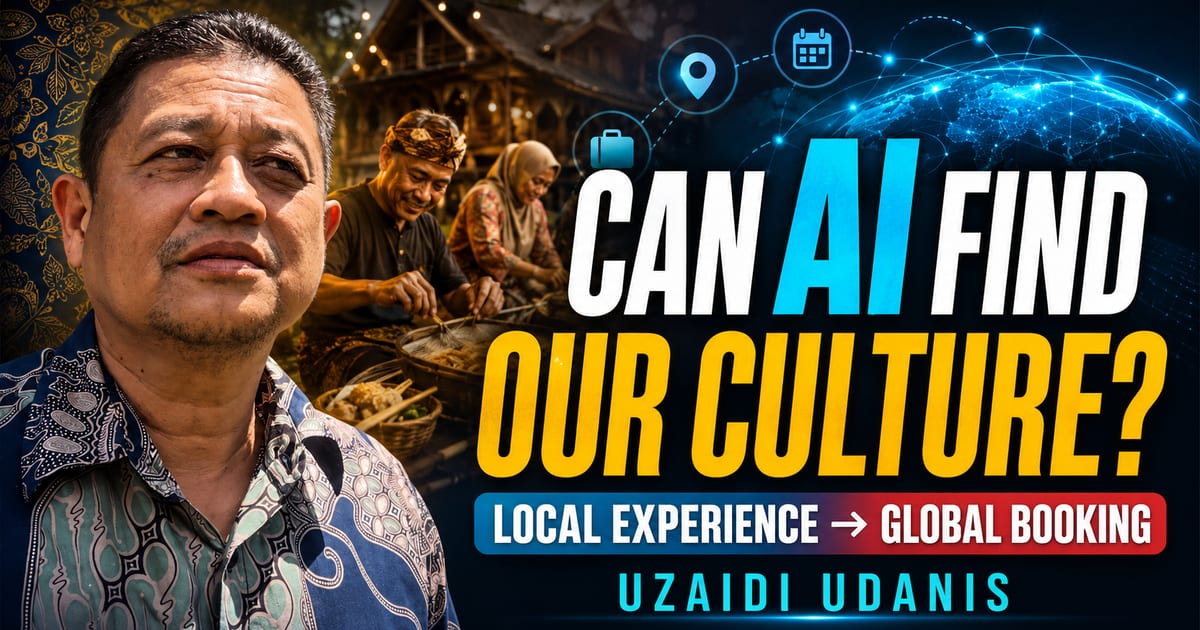
Culture Is Not a Tourism Product Until Travellers Can Find and Book It
Malaysia does not lack culture.
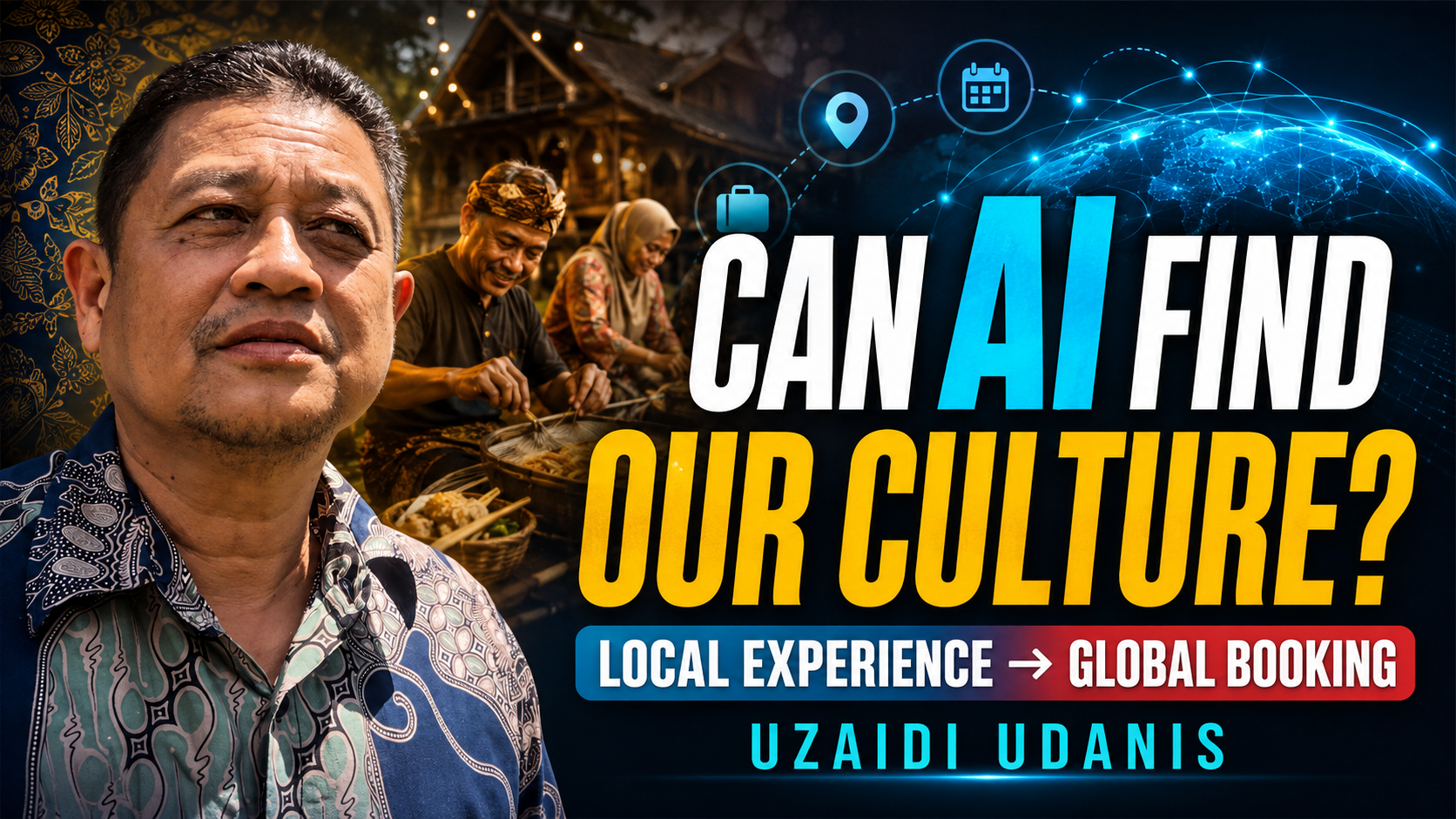
We have traditional food, crafts, music, heritage buildings, kampung stories, indigenous knowledge, local festivals and communities with skills passed down through generations.
But we must ask an uncomfortable question:
How much of this culture can an international traveller actually discover, understand and book?
A cultural asset may be valuable to a community.
But it does not automatically become a tourism experience.
A tourism experience begins when the traveller can:
Discover it
Understand what makes it special
See when it is available
Know how much it costs
Communicate with the operator
Reserve and pay for it
Share it with others
Without this journey, many cultural assets remain beautiful—but economically invisible.
AI Is Becoming the New Front Door to Tourism
Travellers are changing how they plan their holidays.
Instead of searching through dozens of websites, they are increasingly asking AI:
“What unique cultural experiences can I do in Malaysia?”
“Where can I learn batik from a local artisan?”
“Can I join a Malaysian family for a cooking experience?”
“What community-based activities are available near my hotel?”
“Which authentic experiences can I book immediately?”
The important question is no longer only:
Are we promoting Malaysian culture?
The new question is:
Can AI discover, understand and recommend our culture?
If information about an experience is incomplete, scattered or unavailable online, AI may not be able to confidently recommend it.
The experience may exist physically.
But in the digital and AI world, it is almost invisible.
Culture Must Move from Display to Participation
For many years, tourism promoted culture primarily through performances, exhibitions and festivals.
These are still important.
But today’s traveller increasingly wants to participate.
They do not only want to watch batik being made.
They want to make their own batik with a local master.
They do not only want to see Malaysian food.
They want to visit the market, meet the host, cook the food and hear the family story behind the recipe.
They do not only want to photograph a kampung.
They want to cycle through it, meet residents, taste local produce and understand the community’s way of life.
This is the shift from cultural display to cultural experience.
It gives culture greater meaning to the visitor—and greater economic value to the community.
AI Should Strengthen the Human Story
An AI-ready destination does not mean a destination without humans.
It means a destination where AI can discover, understand, recommend and connect travellers to its people, businesses and experiences.
AI cannot replace the warmth of a local host.
It cannot replace the hands of a craft master.
It cannot replace the story of a grandmother teaching a traditional recipe.
But AI can help travellers find them.
It can translate their stories into different languages.
It can help small operators write experience descriptions, prepare itineraries, answer common questions and communicate with international visitors.
AI should not become the experience.
AI should become the bridge to the experience.
The Missing Last Mile
Conferences often discuss AI at a strategic level.
We hear about data, automation, personalisation, smart destinations and digital transformation.
All are important
But local tourism communities need answers to more practical questions:
How do we turn a local asset into a bookable experience?
How should the experience be priced?
What information does AI need to understand it?
How can a small operator become visible without a large marketing budget?
How can the experience be distributed through travel agents and online marketplaces?
How do we ensure that the income reaches local hosts, guides, artisans and communities?
This is tourism’s missing last mile.
Technology is only useful when it creates real opportunities for real people.
From Local Asset to Local Economy
A simple transformation framework can begin with eight steps:
Local Asset → Experience Design → Digital Identity → AI Visibility → Booking Readiness → Market Distribution → Visitor Spending → Community Income
Consider a traditional cooking activity.
It begins as local knowledge.
With proper experience design, it becomes a three-hour cooking experience.
With photographs, storytelling, pricing, availability, FAQs and booking information, it gains a digital identity.
When that information becomes structured and visible online, search engines and AI platforms have a better chance of understanding it.
When the experience is connected to travel agents, hotels, destination platforms and online marketplaces, it can reach paying visitors.
One local recipe can then create income for:
The host
The farmer
The market vendor
The transport provider
The guide
The photographer
The booking platform
The surrounding community
That is how experience creates economy.
We Must Measure More Than Visitor Arrivals
A successful tourism destination should not be measured only by how many tourists arrive.
We should also ask:
How much visitor spending reaches local communities?
How many local experiences are directly bookable?
How many artisans and community hosts have a digital identity?
How many tourism businesses can be discovered through AI?
How many visitors leave the hotel and spend within the surrounding community?
How many cultural skills become sustainable sources of income?
Visitor numbers are important.
But visitor participation and local economic impact are even more meaningful.
However, community-led tourism cannot become resilient through inspiration alone.
Communities need visibility.
Their experiences need to be properly designed.
Their stories need to be understood by AI.
Their products need to be connected to the market.
And visitors must be able to book them.
Perhaps one of the most important conversations should therefore be:
How can AI transform Malaysian culture and community knowledge into discoverable, bookable and profitable local experiences—without removing the human soul that makes them special?
This is not merely a technology conversation.
It is a conversation about cultural survival, community dignity and the future distribution of tourism income.
Malaysia already has the stories.
Malaysia already has the culture.
Malaysia already has the communities.
The next challenge is to make them visible, bookable and AI-ready.
Because culture that is merely displayed may be admired.
But culture that is experienced, valued and fairly monetised can support a community for generations.
About the Author
Uzaidi Udanis is an AI Inbound Tourism Strategist and Founder of Your Inbound Matters, an independent platform connecting more than 600 tourism companies in Malaysia.
He has been involved in inbound tourism since 1986 and is the founder and former three-term President of the Malaysia Inbound Tourism Association. He has also served on the Tourism Malaysia Board under three Tourism Ministers.
Through Your Inbound Matters and the Asnirez tourism operating system, he focuses on helping tourism businesses and local experience operators become visible, bookable and AI-ready for domestic and international markets.
Experience Creates Economy™