
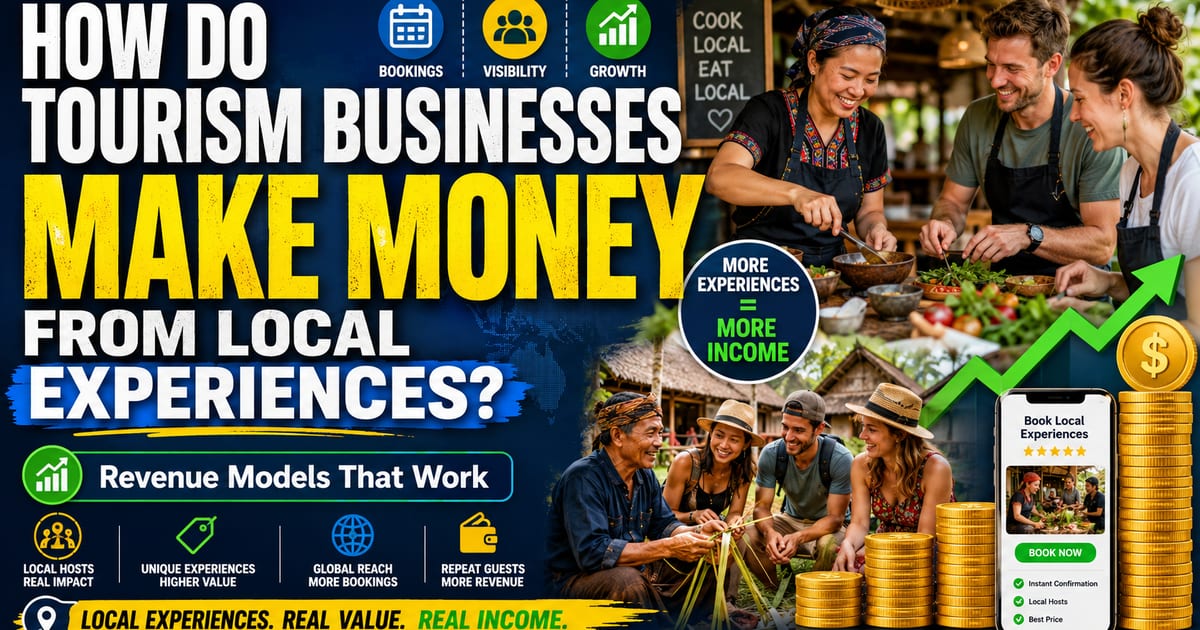
How Do Tourism Businesses Make Money From Local Experiences?
The New Tourism Income Opportunity
Many tourism businesses still think income comes only from selling hotel rooms, transport, tour packages, tickets, or products.
But tourism is changing.
Today, travellers are not only asking:
“Where should I go?”
They are also asking:
“What can I experience?”
They want to cook with locals.
They want to cycle through villages.
They want to learn traditional crafts.
They want to join food trails.
They want to understand local culture.
They want to meet real people.
They want to bring home stories, not just souvenirs.
This is where local experiences become powerful.
A local experience can turn a normal business, skill, product, place, or community asset into a new revenue stream.
A scarf seller can create a scarf styling experience.
A kampung house can host a cooking experience.
A boat operator can sell a sunset cruise.
A farm can create a harvest-and-taste activity.
A mosque community can offer a respectful cultural visit.
A village can offer cycling, food, heritage, and storytelling experiences.
The question is no longer only:
“What can we sell?”
The better question is:
“What can tourists experience, book, pay for, remember, and recommend?”
That is how tourism businesses make money from local experiences.
And this is why I always say:
Experience Creates Economy.
What Is a Local Experience in Tourism?
A local experience is a structured activity that allows tourists to participate in something authentic, local, cultural, educational, scenic, or meaningful.
It is not just sightseeing.
It is not just selling a product.
It is not just saying, “Come and visit us.”
A real local experience gives visitors something to do.
For example:
Cooking chicken rendang with a local host.
Cycling through green paddy fields in a kampung.
Learning 100 ways to wear a hijab or scarf.
Joining a Port Dickson sunset cruise near Kuala Lumpur.
Making batik with a local artisan.
Tasting local noodles with a food storyteller.
Walking through an old town with stories of cinema, coffee, or heritage.
Visiting a farm and learning how local food is grown.
Joining a respectful mosque visit with the imam and local community.
A local experience usually includes:
A host
A story
An activity
A duration
A price
A meeting point
Photos and videos
A booking method
A clear outcome or memory for the tourist
When these elements are properly packaged, the experience becomes a tourism product.
And when it becomes bookable, it can start generating income.
Why Local Experiences Can Be Profitable
Local experiences can be profitable because they are built from assets that already exist.
Many tourism businesses do not need to build something completely new.
They already have:
A location
A skill
A product
A recipe
A culture
A story
A village
A boat
A farm
A kitchen
A workshop
A family tradition
A local network
A community asset
The opportunity is to package these existing assets into experiences tourists are willing to pay for.
This is important because local experiences can create income from several directions at the same time.
A visitor may pay for the experience fee.
Then they may buy a product.
Then they may upgrade to a private session.
Then they may recommend it to friends.
Then they may leave a review.
Then another customer books through a marketplace.
Then a corporate group requests a special package.
Suddenly, one simple local asset becomes multiple revenue streams.
That is the beauty of experience-based tourism.
10 Revenue Models for Local Experience Tourism
1. Experience Fee
The most direct way to make money from local experiences is to charge an experience fee.
This is the amount a tourist pays to join the activity.
For example:
RM80 for a village cycling experience.
RM120 for a local cooking class.
RM150 for a batik-making workshop.
RM180 for a cultural scarf styling experience.
RM250 for a sunset cruise experience.
RM350 for a private heritage walk and meal.
This fee should not be based only on physical cost.
It should include:
Your time
Your hosting
Your knowledge
Your preparation
Your storytelling
Your materials
Your location
Your coordination
Your customer service
Your profit margin
Many local operators underprice themselves because they think they are only selling a product.
But if you are hosting an experience, you are not only selling the item.
You are selling access, learning, culture, time, interpretation, and memory.
That has value.
2. Product Sales After the Experience
This is one of the most powerful revenue models.
A local experience can increase product sales because tourists understand the product better after experiencing the story behind it.
For example:
A scarf seller hosts “100 Creative Ways to Wear a Hijab or Scarf.”
After the experience, tourists may buy the scarf because now it is no longer just fabric.
It has meaning.
It has a story.
They know how to wear it.
They have taken photos with it.
They have an emotional connection to it.
The same applies to batik, coffee, spices, crafts, local snacks, honey, herbs, pottery, books, souvenirs, and handmade products.
The experience creates desire.
The product becomes the souvenir.
This is why local businesses should not separate product sales from experience design.
The experience can become the best sales channel for the product.
3. Marketplace Bookings
Tourism businesses can make money by listing their local experiences on international marketplaces such as Tripadvisor and Viator.
This is important because international tourists are already searching online for things to do.
They may already be in Malaysia.
They may already be in Kuala Lumpur, Penang, Langkawi, Melaka, Sabah, Johor, Ipoh, Port Dickson, or other destinations.
They may search for:
Things to do near me.
Best local experiences.
Cooking class in Malaysia.
Village cycling tour.
Sunset cruise near Kuala Lumpur.
Cultural experience in Malaysia.
Authentic local food experience.
If your experience is not listed, tourists may never find it.
A marketplace helps with visibility and booking.
However, tourism businesses must understand that marketplace bookings usually come with commission or platform costs.
That is why pricing must be done properly.
Do not simply copy the price you use for walk-in customers.
Your marketplace price should consider commission, operations, customer expectations, cancellation terms, and service quality.
The benefit is that marketplaces can connect you to tourists you may not reach by yourself.
This is why I often advise tourism players:
Be present where tourists are already searching.
4. Direct Bookings Through Your Own Platform
Marketplaces are useful.
But tourism businesses should not depend 100% on marketplaces.
You should also have your own platform and booking engine.
Why?
Because your own platform builds your brand.
It allows you to collect direct inquiries.
It gives customers confidence.
It allows you to promote through social media, WhatsApp, Google, email, partners, and content marketing.
It also helps you reduce dependency on third-party platforms.
The best strategy is:
Use marketplaces for discovery. Use your own platform for brand ownership.
For example, a tourist may first discover your experience on social media or Google.
Then they visit your website.
Then they read your story.
Then they see photos, price, itinerary, and availability.
Then they book directly.
That is more powerful than only depending on random walk-in customers.
A tourism business that wants to grow must become visible and bookable.
Your own platform helps you do that.
5. Private Group Experiences
Another revenue model is private group bookings.
Some tourists do not want to join public sessions.
They want a private experience for their family, friends, company, school, or community.
Private groups can be priced higher because they receive more attention, flexibility, and exclusivity.
Examples:
Private cooking experience with Kak Rom.
Private scarf styling workshop.
Private kampung cycling tour.
Private sunset cruise.
Private food trail.
Private cultural visit.
Private craft session.
Private mosque and community learning visit.
Private experiences can be especially attractive to:
Families
Corporate groups
Educational groups
Muslim travel groups
Women travellers
Senior travellers
Student groups
Special interest travellers
High-value independent travellers
This model is useful because one booking can bring several paying participants at once.
Instead of selling one seat, you sell the whole session.
6. Workshop and Learning Fees
Some local experiences can be positioned as workshops.
This works especially well when the host has a skill to teach.
For example:
Cooking chicken rendang.
Making batik.
Learning scarf styling.
Creating local crafts.
Traditional music.
Village farming skills.
Local coffee preparation.
Traditional herbal knowledge.
Photography in kampung scenery.
Food preparation and tasting.
A workshop is valuable because the tourist is not only watching.
They are learning.
They leave with a new skill, new understanding, or something they made themselves.
Workshops can be priced higher than simple visits because they require instruction, preparation, materials, and personal guidance.
This is suitable for entrepreneurs who have knowledge but do not realize that their knowledge can become tourism income.
What you know can be monetized.
But only if you structure it properly.
7. Add-On Sales and Upsells
A local experience can create additional income through add-ons and upsells.
For example:
Extra meal package
Souvenir pack
Printed photo
Transport add-on
Hotel pickup
Premium ingredients
Private photographer
Extended session
Take-home recipe booklet
Certificate of participation
Special family package
Additional product bundle
VIP or private version
For a cooking experience, guests may pay extra for a recipe booklet, spice kit, or lunch package.
For a scarf experience, they may buy an extra scarf, styling pin set, or photo session.
For a cycling experience, they may add a local breakfast or village lunch.
For a sunset cruise, they may add snacks, private charter, or celebration package.
The important thing is not to force upsells.
The add-on must make the experience better.
When done properly, upsells increase revenue while improving customer satisfaction.
8. Partnerships With Hotels, Homestays, Agents, and Local Councils
Tourism businesses can also earn through partnerships.
Many hotels, homestays, travel agents, local guides, and destination stakeholders are looking for things for tourists to do.
If your experience is well-packaged, they can refer customers to you.
Examples:
A hotel recommends your cooking class.
A homestay sends guests to your village cycling tour.
A travel agent includes your experience in an itinerary.
A local council promotes your community experience.
A tour guide brings a small group.
A corporate event organiser includes your workshop.
A school includes your local experience in an educational trip.
Partnerships can help you reduce marketing pressure.
But partners will only promote your experience if it is clear, reliable, priced properly, and easy to book.
That is why documentation is important.
You need:
A short description
Clear price
Duration
Capacity
Photos
Meeting point
What is included
What guests should bring
Commission or partner rate
Booking contact or link
A good local experience must be easy for partners to sell.
9. Content and Brand Monetization
Local experiences can also create content value.
When tourists join your experience, they take photos, videos, reviews, and social media posts.
This content can help attract future customers.
But tourism businesses should also create their own content.
For example:
Short videos of the cooking process
Before-and-after scarf styling
Village cycling scenery
Behind-the-scenes preparation
Tourist reactions
Local host stories
Customer testimonials
Educational clips
Blog posts
YouTube videos
Instagram reels
TikTok videos
Content helps people understand your experience before they book.
Over time, content can create trust and brand recognition.
For example, if someone searches:
“How do tourism businesses make money from local experiences?”
and they find your article, video, and workshop, you become the expert in their mind.
This is exactly why tourism businesses should not only create experiences.
They should also create content around the experience.
Because content brings attention.
Attention brings trust.
Trust brings bookings.
10. Advisory, Training, and Licensing Models
For experienced tourism players, local experience knowledge can become another income model.
If you know how to create, package, list, and promote local experiences, you can offer:
Training
Advisory
Done-with-you support
Product development
Marketplace listing support
Platform setup
Booking engine setup
Experience audits
Local council advisory
Community tourism development
Destination experience strategy
This is especially useful for people who have experience in tourism and want to help others create income from local assets.
For example, through Your Inbound Matters, we help tourism players and entrepreneurs create local experiences step by step.
The entry point is the 7-day RM97 workshop.
From there, businesses that need deeper help can continue with advisory support, booking platform setup, and international marketplace onboarding.
This shows that local experience tourism does not only create income from tourists.
It can also create income from knowledge, advisory, systems, and product development.
The Local Experience Revenue Stack
A strong tourism business should not depend on only one income source.
Instead, it should build a revenue stack.
For example, one local cooking experience can generate income from:
Experience fee
Private group booking
Product sales
Recipe booklet
Spice kit
Transport add-on
Hotel partnership
Marketplace booking
Direct booking
Corporate workshop
YouTube content
Future advisory or training
This is how one simple experience becomes a business model.
The goal is not just to create one activity.
The goal is to create an income ecosystem around the activity.
Example 1: Chicken Rendang Cooking Experience
Let’s say Kak Rom hosts a chicken rendang cooking experience in her house kitchen.
The basic offer:
Tourists come to her home, learn about Malaysian ingredients, prepare spices, cook chicken rendang, enjoy the meal, and take photos.
Possible revenue streams:
Experience fee per person
Private group fee
Extra lunch package
Recipe booklet
Spice pack to take home
Transport add-on
Marketplace booking
Direct booking from website
Partnership with homestays
Short cooking videos for promotion
Corporate team-building version
This is no longer just cooking.
It becomes culture, food, learning, hospitality, and memory.
That is experience-based tourism.
Example 2: Kampung Cycling Through Paddy Fields
A kampung cycling experience can also create several income streams.
The basic offer:
Tourists ride bicycles through green paddy fields, visit village houses, stop for local snacks, take photos, and learn about rural life.
Possible revenue streams:
Cycling experience fee
Bike rental
Local breakfast add-on
Village lunch
Local guide fee
Photo package
Homestay bundle
School group package
Marketplace booking
Direct booking
Partnership with hotels
Community fund contribution
This kind of experience can help distribute tourism income into the community.
The guide earns.
The food provider earns.
The bicycle provider earns.
The homestay earns.
The local shop earns.
This is why local experiences are powerful.
They do not only benefit one company.
They can benefit the local ecosystem.
Example 3: Scarf or Hijab Styling Experience
A scarf seller can create an experience called:
100 Creative Ways to Wear a Hijab or Scarf
The basic offer:
Tourists learn different scarf styles, understand cultural meaning, take photos, and choose their favourite look.
Possible revenue streams:
Workshop fee
Scarf sales
Styling accessory sales
Photo session
Private women-only group
Cultural fashion package
Marketplace booking
Direct online booking
Collaboration with hotels
Social media content
Online version of the workshop
This is a very good example because the original product is simple.
But once storytelling and activity are added, the product becomes an experience.
The experience then increases the value of the product.
Example 4: Port Dickson Sunset Cruise
For many tourists, the phrase “sunset cruise” may make them think of Langkawi.
But Port Dickson has a strong opportunity because it is closer to Kuala Lumpur.
The positioning can be:
Enjoy a sunset cruise near Kuala Lumpur without travelling all the way to Langkawi.
Possible revenue streams:
Seat-in-coach sunset cruise
Private charter
Couple package
Family package
Snacks and drinks add-on
Hotel pickup
Birthday or anniversary setup
Marketplace booking
Direct booking
Hotel and agent partnerships
This is a good example of how positioning can create demand.
The boat may already exist.
The sea may already be there.
The sunset may already happen every evening.
But once the experience is packaged, listed, and promoted, it becomes a bookable tourism product.
Why Bookability Is the Key to Revenue
Many tourism businesses have good ideas.
But good ideas do not automatically make money.
A local experience must be bookable.
That means tourists should be able to see:
What the experience is
Who it is for
How long it takes
What is included
What is not included
Where to meet
How much it costs
What photos look like
What previous guests say
How to reserve a spot
How to pay
How to contact the host
If these details are missing, tourists may hesitate.
International tourists especially need clarity.
They may not understand your location.
They may not know your culture.
They may not be confident to WhatsApp randomly.
They may not know whether the experience is professional or safe.
So you must reduce uncertainty.
A clear booking page increases trust.
A clear listing increases confidence.
A clear itinerary increases conversion.
A clear price helps decision-making.
That is why bookability is not a small detail.
Bookability is the bridge between interest and income.
Common Mistakes That Reduce Revenue
Many local experience operators lose money because they make these mistakes:
They price too low.
They do not include marketplace commission in pricing.
They do not have good photos.
They do not explain the story.
They do not have a proper booking page.
They depend only on walk-in customers.
They are not listed on international marketplaces.
They do not create content.
They do not offer private group options.
They do not collect reviews.
They do not build partnerships.
They do not have upsells or add-ons.
They treat the experience as a side activity, not a product.
If you want to make money from local experiences, you must treat the experience seriously.
It must have structure.
It must have price.
It must have a story.
It must have photos.
It must have booking.
It must have promotion.
It must have follow-up.
That is how a local activity becomes a revenue model.
How to Start Creating Income From Local Experiences
If you are a tourism player or entrepreneur, start with these questions:
What local asset do I already have?
What can tourists do, learn, taste, try, or photograph?
What story makes this experience meaningful?
Who is the ideal tourist for this experience?
How long should the activity be?
What should the price be?
What photos and videos do I need?
Where should I list it?
How will tourists book it?
Who can help promote it?
Do not wait until everything is perfect.
Start with one experience.
Make it clear.
Make it simple.
Make it bookable.
Then improve it based on feedback.
The first version does not need to be perfect.
But it must exist.
Because tourists cannot book an idea that is only inside your head.
The Future: From Product Seller to Experience Creator
The future of tourism does not belong only to those who sell tours.
It belongs to those who know how to create experiences that matter.
Experiences that tourists remember.
Experiences that markets value.
Experiences that local communities benefit from.
If you are a local business owner, your biggest opportunity may not be a new product.
It may be a new way of presenting what you already have.
A product can be copied.
But your story, your people, your local setting, your way of hosting, and your authentic experience are harder to copy.
This is where local tourism businesses can compete.
Not by being the cheapest.
But by being meaningful, visible, bookable, and memorable.
Want to Create Your Own Local Experience Revenue Model?
If you want to create your own local experience but do not know where to start, join the:
Create Your Own Local Experience From Zero to Bookable in 7 Days Workshop
Workshop fee: RM97
In this 7-day workshop, we guide you step by step to create:
A clear local experience idea
A draft itinerary
A pricing structure
A photos and videos plan
A marketplace-ready description
A booking page direction
A complete local experience concept ready to promote
This is suitable for tourism players, entrepreneurs, local business owners, homestay owners, food operators, craft makers, local guides, boat operators, and anyone who wants to create income from international tourists.
After the workshop, businesses that want more support can explore advisory services such as:
Done-with-you local experience creation
Platform and booking engine setup
Listing support for Tripadvisor, Viator, and other international marketplaces
Promotion strategy
Tourism product development advisory
Local council and destination advisory
The first step is simple.
Turn what you already have into something tourists can book.
That is how tourism businesses make money from local experiences.
That is how local assets become income.
That is how experience creates economy.
Frequently Asked Questions
How do tourism businesses make money from local experiences?
Tourism businesses make money from local experiences through experience fees, product sales, marketplace bookings, direct bookings, private group packages, workshops, add-ons, partnerships, content, and advisory services.
What is a local experience revenue model?
A local experience revenue model is the way a tourism business earns income from a structured activity based on local assets such as food, culture, craft, nature, village life, heritage, lifestyle, or community knowledge.
Can a small business create income from local experiences?
Yes. Small businesses can create income by turning existing products, skills, stories, or locations into bookable activities for tourists. Examples include cooking classes, craft workshops, scarf styling sessions, farm visits, village cycling, and sunset cruises.
Do I need to list my local experience on Viator or Tripadvisor?
It is highly recommended if you want to reach international tourists who are already searching for things to do. However, you should also build your own platform and booking engine so you can grow your own brand and direct bookings.
What is the easiest local experience to start with?
The easiest experience to start with is usually based on something you already do well, such as cooking, crafting, farming, guiding, hosting, storytelling, styling, or showing a local place that visitors may find interesting.
How much should I charge for a local experience?
Your price should include your time, preparation, materials, hosting, storytelling, marketplace commission, customer service, and profit margin. Do not price only based on product cost because an experience includes knowledge and memory.
Why are local experiences important for tourism?
Local experiences help tourists connect with people, culture, food, stories, and communities. They also help distribute tourism income to small businesses and local communities instead of concentrating all spending in major attractions.
A local experience is not just an activity.
It is a business model.
It can sell the experience.
It can sell the product.
It can create content.
It can attract partners.
It can create direct bookings.
It can build your brand.
It can generate new income from assets you already have.
That is the power of experience-based tourism.
And for many tourism businesses, this may be the next big opportunity.
Experience Creates Economy.
Uzaidi Udanis
Founder, Your Inbound Matters
yourinboundmatters.com