
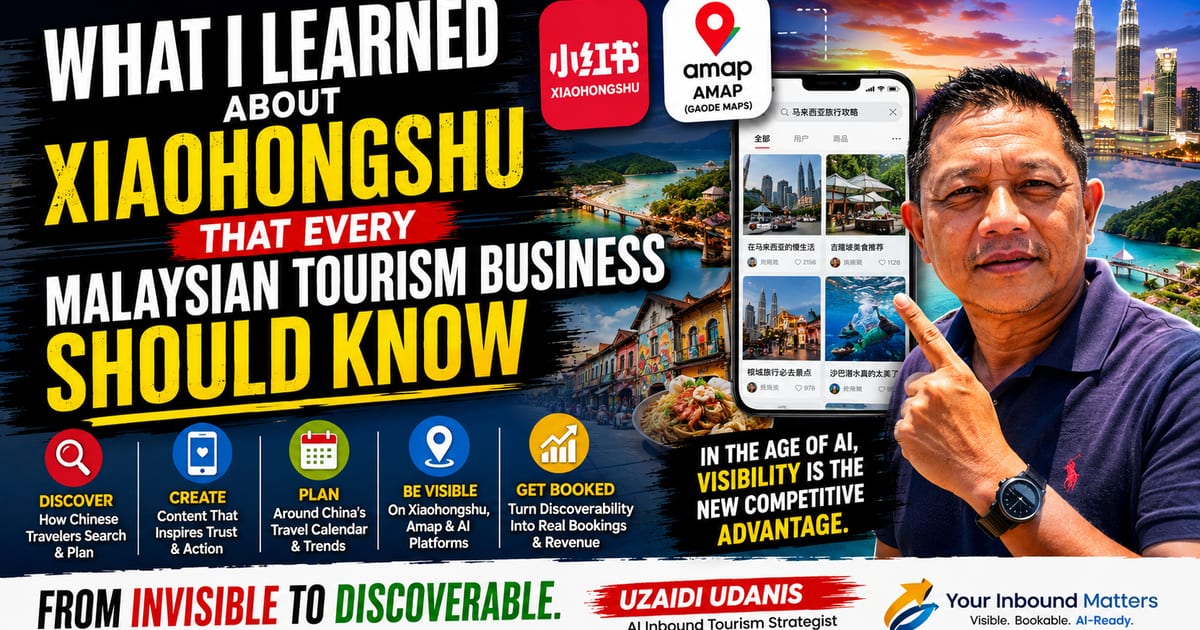
What I Learned About Xiaohongshu That Every Malaysian Tourism Business Should Know
Why becoming visible matters more than ever in the AI era
By Uzaidi Udanis
AI Inbound Tourism Strategist
Your Inbound Matters
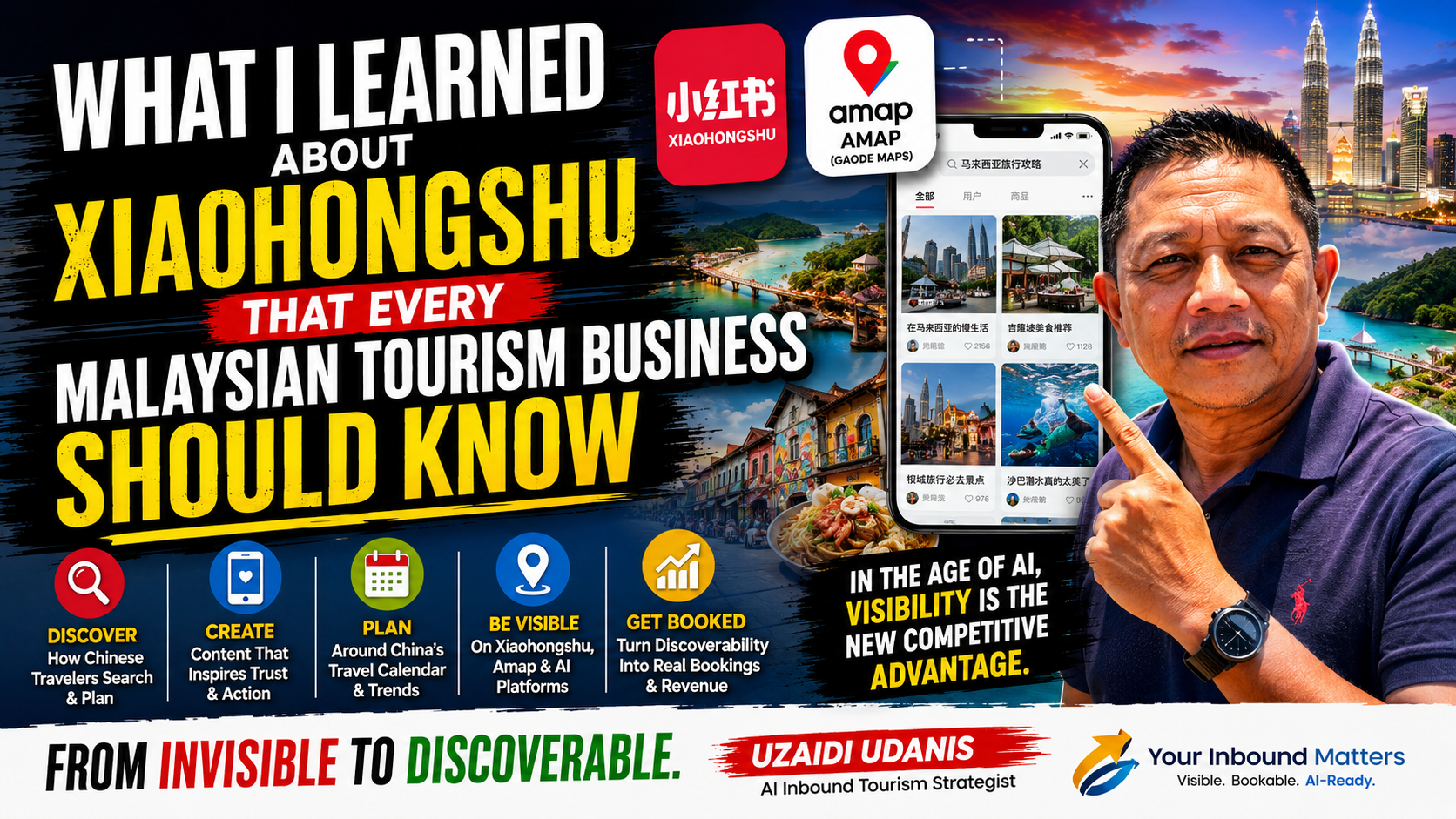
Yesterday, I attended an industry sharing session on two platforms that many Malaysian tourism businesses have heard of but few truly understand—Xiaohongshu (RED) and Amap (Gaode Maps).
As someone who has been involved in Malaysia’s inbound tourism industry since 1986, I have seen many changes in how international travellers discover destinations.
We have gone from printed brochures…
…to websites.
From websites…
…to online travel agencies.
From online travel agencies…
…to social media.
Today, we are entering another new era.
An era where AI, search behaviour and content discovery are shaping travel decisions long before a tourist books a flight.
That is why I attended this session—not simply to learn about another marketing platform, but to understand how Chinese travellers are discovering destinations today.
By the end of the presentation, one message became crystal clear.
The future of inbound tourism is no longer just about having a website.
It is about becoming discoverable.
Chinese Travellers Are Searching Differently
Many Malaysians think Xiaohongshu is simply China’s version of Instagram.
After attending this session, I realised that description is far too simplistic.
Xiaohongshu has become something much bigger.
It combines the functions of a search engine, a social media platform, a travel inspiration website, a review platform and a lifestyle community.
Instead of asking a travel agent,
Chinese travellers search for things like:
Best local breakfast in Penang
Hidden waterfalls near Ipoh
Things to do in Langkawi
Best café in Kuala Lumpur
Family-friendly attractions in Malaysia
They are looking for real experiences shared by real people.
That immediately made me think about our tourism industry.
How many Malaysian tourism businesses are creating content that answers these questions?
Unfortunately, not many.
Discovery Happens Before Booking
One slide particularly caught my attention.
It explained how users first spend time browsing interesting content before moving into deep search mode.
This is very different from traditional tourism marketing.
Previously, the journey looked like this:
Advertisement
↓
Travel Agent
↓
Booking
Today it looks more like this:
Content
↓
Inspiration
↓
Search
↓
Trust
↓
Booking
This is exactly why I have been saying that tourism businesses need to become visible, bookable and AI-ready.
If travellers cannot discover you…
They cannot book you.
Quality Content Keeps Working
One of the most interesting insights was that high-quality Xiaohongshu content continues generating views long after it is published.
Unlike many social media platforms where a post disappears after a day or two, Xiaohongshu content keeps resurfacing because people continue searching.
That reminded me of something I often tell tourism businesses.
Every useful article…
Every helpful video…
Every authentic local story…
Becomes another digital doorway leading travellers to your business.
Content is no longer just marketing.
Content has become part of your tourism product.
Malaysian Tourism Needs Better Stories
As I listened to the presentation, another thought came to mind.
Malaysia does not have a shortage of attractions.
We have a shortage of storytelling.
Many tourism businesses still promote themselves using phrases like:
“Beautiful homestay.”
“Great customer service.”
“Affordable packages.”
Those descriptions could apply to thousands of businesses.
Chinese travellers are searching for something much more specific.
They want experiences.
Imagine the difference between these two descriptions.
“We offer village tours.”
versus
“Spend a morning harvesting herbs with a local family before learning how to cook traditional Malay dishes.”
Which one would you remember?
The product is almost the same.
The story is completely different.
Search Keywords Matter More Than Ever
Another lesson from the session was how Chinese users search using highly specific keywords.
Instead of searching for “Malaysia,”
they search for:
Mid Valley food
TRX restaurants
Pavilion Bukit Jalil cafés
Hidden coffee shops in Penang
This is an important lesson for tourism businesses.
Instead of creating generic pages titled:
“Our Tour Package”
consider creating content such as:
Five Authentic Things To Do in Kuala Kangsar
Why Chinese Visitors Love Malaysia’s Village Experiences
Best Local Breakfast Near George Town
Hidden Nature Experiences in Perak
The more specific your content becomes,
the easier it is for search engines, AI platforms and travellers to understand what you offer.
Authenticity Wins
One slide discussed avoiding overly promotional language.
This was another valuable reminder.
Today’s travellers trust authenticity more than advertising.
Instead of saying:
“We are the best.”
Show your guide explaining local history.
Show your guests learning to cook.
Show the sunset.
Show the smiles.
Show the unexpected moments.
Stories create trust.
Trust creates bookings.
Marketing Must Follow the Traveller’s Calendar
Another interesting takeaway was the importance of planning content around the Chinese calendar.
Campaigns are built around major travel periods such as:
Chinese New Year
Labour Day
Summer Holidays
Mid-Autumn Festival
National Day
Singles’ Day
Double 12
This means tourism businesses should prepare content weeks or even months before these travel periods begin.
Marketing should not start after travellers have already made their decisions.
Consistency Is More Powerful Than One Viral Post
One slide showed a simple framework.
Official Account.
Regular Content.
Creator Collaborations.
Continuous Optimisation.
That reminded me that successful tourism marketing is rarely about one viral video.
It is about showing up consistently.
Helping travellers.
Answering questions.
Sharing useful experiences.
Over time, trust grows.
Visibility grows.
Bookings follow.
My Biggest Takeaway From The Event’s Yesterday ;
As I left the session, I realised something.
Malaysia does not have a tourism product problem.
Malaysia has a discoverability problem.
We have beautiful destinations.
Wonderful food.
Rich culture.
Amazing local experiences.
But if Chinese travellers cannot discover them…
They simply don’t exist in their travel planning process.
What This Means for Your Tourism Business
For me, the future is becoming clearer every day.
Tourism businesses need to think beyond brochures.
Beyond websites.
Beyond social media likes.
We need to build businesses that are:
Visible.
Discoverable.
Bookable.
AI-ready.
That is exactly why we created Your Inbound Matters.
Our mission is not just to help tourism businesses build websites.
It is to help them become easier to discover by travellers, search engines, AI assistants and global marketplaces.
Because in the AI era…
Visibility is becoming the new competitive advantage.
The Xiaohongshu and Amap session confirmed something I have believed for a long time.
Inbound tourism is changing.
Travellers are changing.
Technology is changing.
The businesses that continue relying on yesterday’s marketing methods may struggle to attract tomorrow’s travellers.
The businesses that learn how to become visible, tell authentic stories and create bookable experiences will have a significant advantage.
As an AI Inbound Tourism Strategist, I believe the next decade of tourism belongs to businesses that understand one simple truth:
Before travellers can book you… they must first discover you.
And in the age of AI, discoverability has never been more important.
About the Author
Uzaidi Udanis is an AI Inbound Tourism Strategist and founder of Your Inbound Matters, an independent platform helping tourism businesses become visible, bookable and AI-ready. Through AI, digital strategy, experience design and industry education, he works with tourism businesses and destinations to connect local experiences with global travellers.