
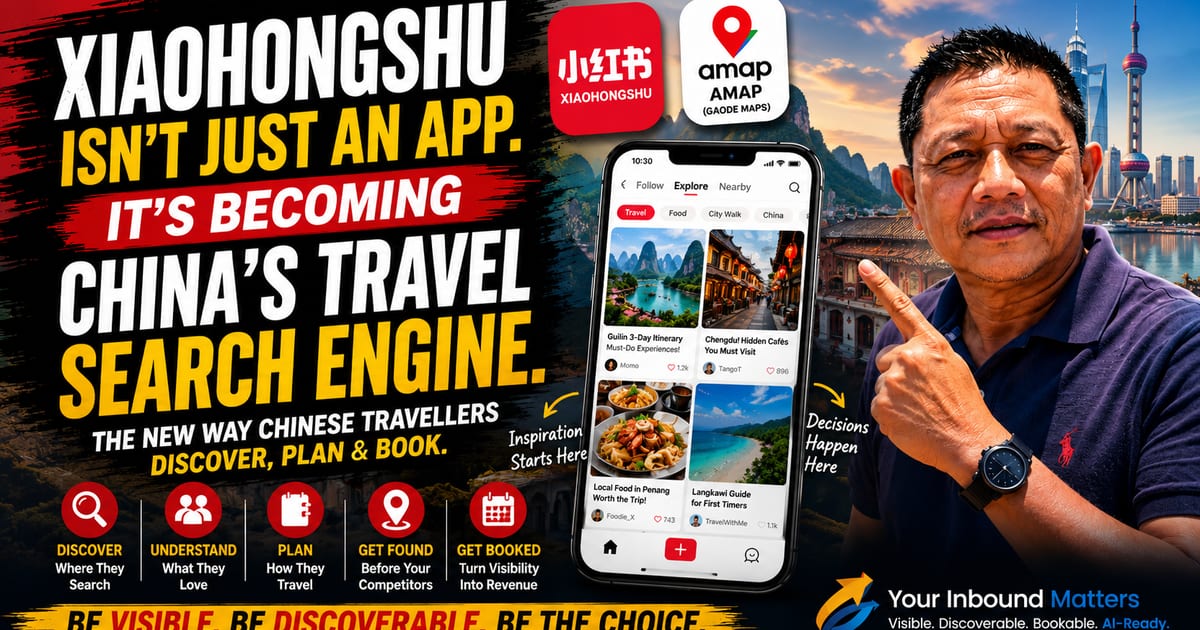
Xiaohongshu Isn’t Just an App. It’s Becoming China’s Travel Search Engine
Xiaohongshu Isn’t Just an App. It’s Becoming China’s Travel Search Engine.
If your tourism business isn’t there, you’re invisible before travellers even book.
By Uzaidi Udanis
AI Inbound Tourism Strategist | Your Inbound Matters
A few days ago, I attended a sharing session on Xiaohongshu (RED) and Amap, where industry experts demonstrated how Malaysian tourism businesses can leverage these platforms to reach Chinese travellers.
Then yesterday, I came across an article in The Star with a headline that immediately caught my attention:
“Indispensable Xiaohongshu App Fuels Chinese Tourism.”
I smiled.
Not because it was new information.
But because it confirmed something I’ve been saying for months.
The battle for Chinese tourists is no longer won at the booking stage.
It’s won at the discovery stage.
And if your tourism business isn’t part of that discovery process, someone else is.
Let Me Ask You A Simple Question
When was the last time you booked a hotel without reading reviews?
Probably never.
Now imagine an entire generation of travellers doing something even more powerful.
They don’t start with Google.
They don’t start with a travel agent.
They don’t even start with Booking.com.
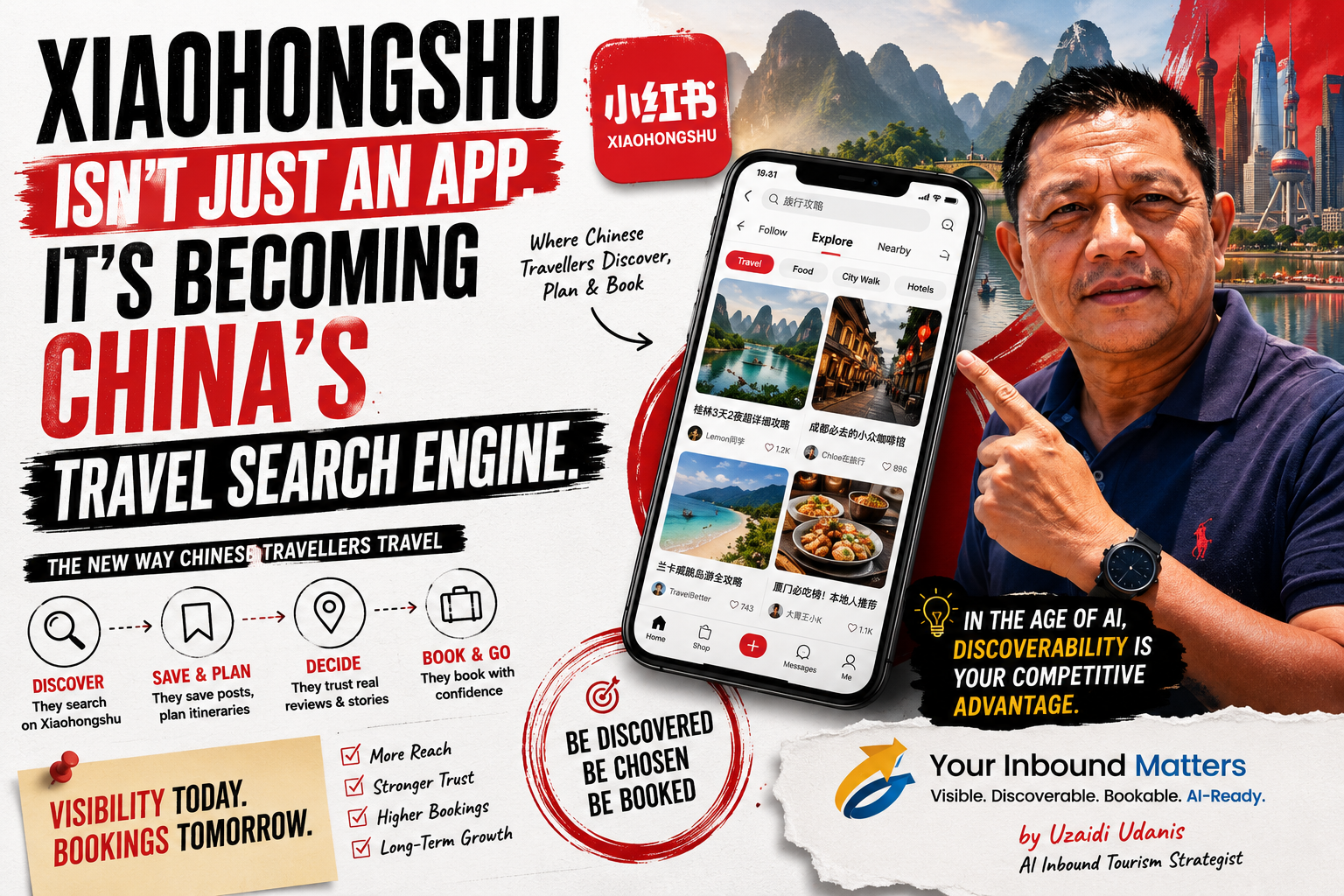
They start with Xiaohongshu.
They search.
They browse.
They compare.
They save posts.
They plan itineraries.
Only then do they book.
That’s exactly what the article highlighted.
Young Chinese travellers now use Xiaohongshu to discover destinations, restaurants, city walks, photography spots and even complete travel routes before making travel decisions.
Think about what that means.
You’re Not Competing With Other Tour Operators
You’re competing with content.
That’s the shift.
For years, tourism businesses believed their competitors were:
Another hotel.
Another homestay.
Another DMC.
Another tour operator.
Not anymore.
Today your biggest competitor might be:
A traveller’s photo.
A food review.
A “Top 10 Hidden Places in Penang” post.
A three-minute video about a village experience.
Whoever gets discovered first usually gets considered first.
Visibility Is The New Currency
One story from the article stood out to me.
An 18-year-old photographer in Beijing explained that photographers with large Xiaohongshu followings attract more customers, while those without an online presence rely on calling out to people walking past.
Read that again.
Same location.
Same camera.
Different visibility.
Different income.
That’s not just true for photographers.
It’s becoming true for:
Hotels
Restaurants
Nature guides
Homestays
Museums
Shopping malls
Tourism destinations
Visibility is becoming a business asset.
Malaysian Tourism Has A Product Problem…???
No.
Let me correct that.
Malaysia doesn’t have a product problem.
We have a discoverability problem.
We have:
Amazing food.
Beautiful islands.
Rainforests.
UNESCO heritage cities.
Indigenous culture.
Authentic village experiences.
But ask yourself honestly.
How much of this is easily discoverable by a Chinese traveller searching in Mandarin?
If the answer is “not much,” then we’re leaving opportunities on the table.
This Is Why I Keep Talking About AI
Some people ask me,
“Why do you call yourself an AI Inbound Tourism Strategist?”
Because AI changes how people discover information.
Xiaohongshu changes how Chinese travellers discover destinations.
Amap changes how they navigate once they’re there.
Google changes how international travellers search.
ChatGPT, Gemini and other AI assistants are changing how recommendations are delivered.
They’re all connected by one idea.
Discoverability.
The businesses that organise their digital presence well will increasingly become the businesses that AI recommends.
Tourism Businesses Need To Think Like Publishers
Here’s a challenge.
Stop asking:
“How do I advertise my package?”
Start asking:
“What questions are travellers already asking?”
For example:
Instead of:
“3D2N Cameron Highlands Tour.”
Create content like:
Where can I drink the best tea in Cameron Highlands?
Five cafés with amazing mountain views.
Hidden mossy forest photography spots.
How to spend 48 hours in Cameron Highlands like a local.
One sells.
The other helps.
Guess which one people trust more?
Tourism Malaysia Is Already Moving
This isn’t just theory.
Tourism Malaysia has already partnered with Xiaohongshu to promote Malaysia through the platform’s “Discover–Plan–Experience” ecosystem ahead of Visit Malaysia 2026.
The collaboration focuses on authentic storytelling, official content, analytics and creator engagement.
That’s a strong signal.
The question is whether individual tourism businesses are moving at the same pace.
My Biggest Takeaway
The Star article called Xiaohongshu “indispensable.”
I think that’s exactly the right word.
Not because every Malaysian tourism business needs to become a Xiaohongshu expert overnight.
But because we need to understand one fundamental change.
Travellers don’t discover destinations the way they used to.
If you’re still relying only on brochures, trade fairs and Facebook posts, you’re marketing for yesterday’s traveller.
Tomorrow’s traveller discovers through:
Search.
Stories.
Recommendations.
AI.
Community.
The Future Belongs To Discoverable Businesses
At Your Inbound Matters, we believe the future of inbound tourism is built on four pillars:
Visible.
Can travellers find you?
Discoverable.
Do you appear where they search?
Bookable.
Can they take action immediately?
AI-Ready.
Can search engines and AI understand and recommend your business?
These aren’t buzzwords.
They’re becoming competitive advantages.
I’ve spent almost four decades in Malaysia’s inbound tourism industry.
I’ve watched brochures become websites.
Websites become OTAs.
OTAs become social media.
Now we’re entering another transformation.
Search is becoming conversational.
Discovery is becoming algorithmic.
Trust is becoming community-driven.
The businesses that adapt won’t just attract more Chinese travellers.
They’ll be better prepared for the future of global tourism.
Because before a traveller books your experience…
They have to discover you.
And today, discoverability is no longer optional. It’s your competitive advantage.
About the Author
Uzaidi Udanis is an AI Inbound Tourism Strategist and founder of Your Inbound Matters, helping tourism businesses become Visible, Discoverable, Bookable and AI-Ready through digital strategy, AI adoption and inbound tourism innovation.